
How to do your own legal work with AI
Focus on your objectives and loop in a lawyer at the last mile
Written by

Ryan Wenger
Startups
Ryan is the CEO and cofounder of Inhouse. He exited his last startup and has nearly 20 years of experience as a corporate lawyer.
On this page
LLMs are trained to be agreeable.
Ask it for an employment agreement and it will give you one instantly without any questions. In most situations, this a feature, but in legal it’s a bug.
Lawyers are trained to challenge. Ask us for an employment agreement and get back a series of questions. The law is profoundly nuanced and our clients often ask for the wrong document, strategy, or term. Turns out, most of the time, business owners need an offer letter.
AI’s hesitancy to challenge bad prompts will be costly. Americans are increasingly flooding ChatGPT for legal self service and the consequences are just starting to show up in court. In March, OpenAI was sued for inducing a woman to file a frivolous lawsuit.
The lesson isn't to avoid AI. Lawyers are too expensive for the daily needs of ordinary people. It's to use AI right.
This is our mission. I run Inhouse, the world's most popular AI for legal self-help--with more than 7 million chats. Lawyers from our law firm review the AI's answers and drafts everyday and update our model to obtain the right context.
We publish these Playbooks to open-source their insights. I wrote this article to share the broadest lesson--how to get reliable legal work from AI.
There are two big principles: First, describe your objective, not the legal strategy. Second, loop in a lawyer for the last mile. Inhouse includes these two features, but the lessons will help you get better results from any LLM.
1. Vibe-code legal work, don’t micromanage it.
I use the vibe coding analogy since my clients are startups. Vibe coding is a new capability that enables non-coders to build software by describing the product they want, instead of writing the code themselves.
Legal work should be approached the same way. Do not start by naming the document. That's like writing the code. Start by explaining the outcome. What's your goal, the background, and your concerns? Attach the relevant emails or screenshots. Share your legal idea as a reference. Tell the AI to be a lawyer and that you’re the client.
Here are a few examples:
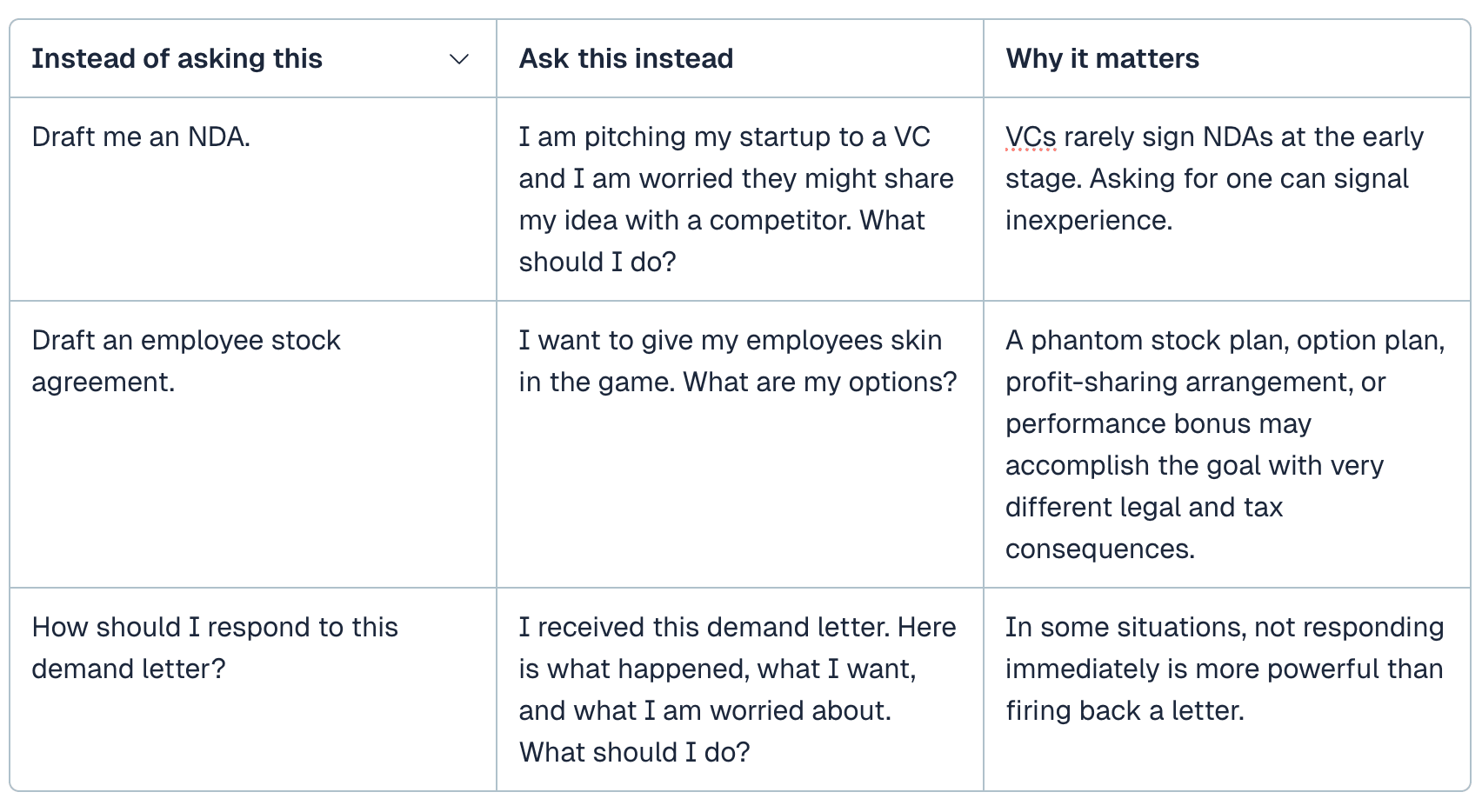
The point is simple: describe the destination, not the vehicle. That is legal vibe-coding.
2. Bring in a lawyer for the last mile
Even if you use AI well, a lawyer still adds two things AI cannot reliably provide.
The first is tribal knowledge. LLMs are trained on statutes and finished contracts, not experts’ mental models grounded in real world experience. Experienced lawyers know when a clause will invite push back. They know when not to respond to a demand letter.
The second is accountability. If a lawyer makes a serious mistake, they have professional obligations and may have malpractice insurance. If an AI tool makes the same mistake, you are usually left with the tool’s terms of use (often limited to what you paid), disclaimers, and warnings that you should have consulted a lawyer.
The solution is to bring together AI and lawyers. Use AI to understand the issue, organize the facts, create a first draft, and prepare your questions. Then bring in a lawyer to review the strategy and finalize the document.
The formula is simple: AI-assisted research → AI-assisted draft → Lawyer final review.
That is how regular people can get quality legal help at a price they can actually afford.
How to find a lawyer who will work this way - frame it right
The hard part is finding a good lawyer who is willing to step into an AI-assisted workflow. Many lawyers will not want to review an AI-generated document. They will prefer to restart the project from scratch using their own process and templates. (Or, increasingly, they’ll use AI and pad their margin.)
Here is how to overcome this bias:
Make the work digestible. Ask AI to turn your AI work into a short memo for a lawyer. The memo should explain the facts, your objective, the key legal issues, the open questions, and what you want the lawyer to review.
Do not frame it to the lawyer as, “rubber-stamp this AI document.” No good lawyer will oblige. Say this instead: “I used AI to organize the facts and prepare a first draft. I would like you to review the strategy and finalize the document.”
That framing respects the lawyer’s role and makes the project easier to accept.
Look for small and local firms. Big firms are usually not built for this kind of work. They are more likely to run their normal process at their normal price.
Smaller firms and solo attorneys are often more flexible. They may be more willing to review a discrete issue, provide limited-scope advice, or start with a short paid review before expanding the project.
Start with a limited hourly review. Ask whether the lawyer can begin with one or two hours of review before you commit to a larger retainer.
If they require a retainer, ask whether they can start with a smaller amount for a limited project. The goal is not to avoid paying lawyers. The goal is to spend lawyer time on the parts where legal judgment matters most.